To the untrained eye, the field of women’s health — more specifically, reproductive health — looks pretty bleak these days.
Reproductive rights and access to safe, legal abortions have been stripped back in states across the country following the overturning of Roe v. Wade in 2022, leaving pregnant people in crisis.
Meanwhile, states with looser abortion policies are flooded with an influx of patients they can’t possibly manage. And giving birth isn’t exactly safe, either. In 2021, Black women’s maternal mortality rate was 69.9 deaths per 100,000 live births, 2.6 times the rate for white women, according to the U.S. Center for Disease Control & Prevention.
These persistent racial disparities reflect the infuriating reality that not only does the state of reproductive health seem particularly troubling in modern-day America, historically, it always has been.
The field of modern gynecology itself was built on the trauma of Black enslaved women.
The work of Dr. James Marion Sims informs much of what is practiced in gynecology today, and Sims admitted in his own autobiography that most of the developments made in his practice were carried out via experimentation on enslaved women, mostly without anesthesia.
The fight for equitable care — whether it’s regular annual exams, abortion, birth control and contraception, chronic conditions like endometriosis, menstrual health, pregnancy, birth, or simply being listened to by one’s doctor — is generations old.
And while many people across the country continue to face real barriers to care — and the potentially deadly consequences of those barriers — progress is being made.
In 2025, the Gates Foundation announced a $2.5 billion investment in women’s health research. Elected officials in local and federal offices continue to fight for reproductive rights. And on the front lines, doctors, nurses, and reproductive health professionals of all stripes work tirelessly to make a difference in the lives of their patients.
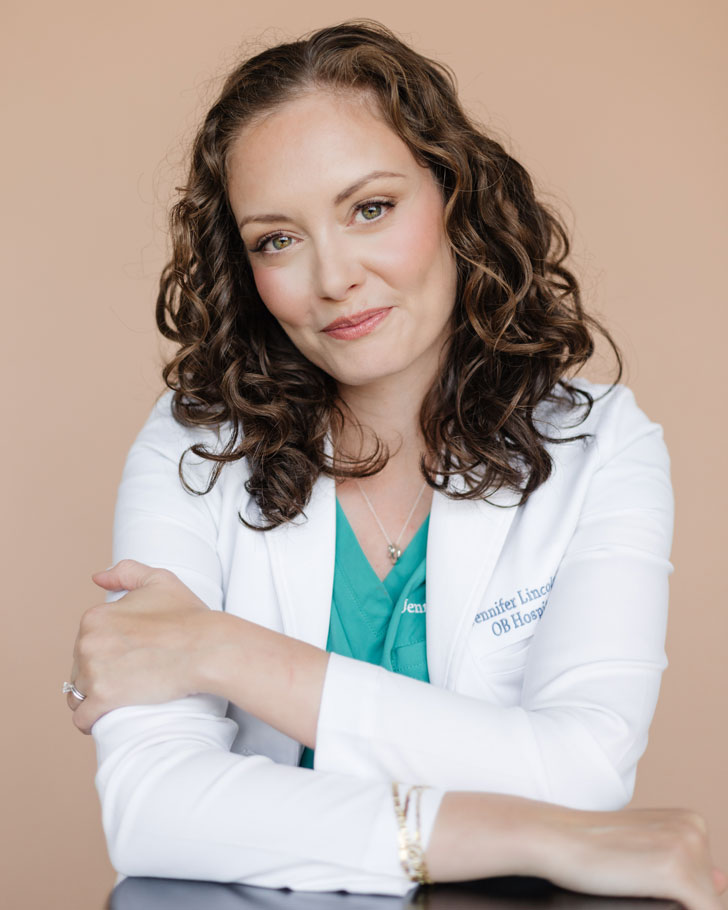
Dr. Jennifer Lincoln, known as “the internet’s OB-GYN,” is one of them. We sat down to speak with her about reproductive justice, the power of sex education, her new book, “The Birth Book” (on shelves now), and why she still has hope for women’s health. Our conversation is below.
Answers have been edited for length and clarity.
In Conversation with Dr. Jennifer Lincoln, the Internet’s OB-GYN
Kamrin Baker, Managing Editor of Good Good Good: To start, tell me about you. How did you find yourself doing this work?
Dr. Jennifer Lincoln: I am a board-certified OB-GYN. I work as an OB-hospitalist, which means that I'm just on labor and delivery. But it was 2018 when I started my professional usage of social media, and it was so great to see that it could be used as a platform for education.
Doctors don't always do a great job of breaking things down, so I wanted to use social media to educate, to make complicated stuff not-so-complicated.
And for me, it goes all the way back to my all-girls Catholic education. I was never taught any of the stuff that I educate about now. And the internet — because I'm from the 1900s, as my kids say — the internet was not around then.
I’m always thinking that I want to explain these things to the 16-year-old version of me.
GGG: Tell me about the hurdles women face accessing reproductive health care in the U.S.
Dr. L: When I think of “hurdle,” I think of “American Ninja Warrior,” where it's that final wall they have to climb up, and there’s like there's butter and grease, and you just can't do it, and that’s what it’s like.
In general, when it comes to the hurdles that all Americans face, it's access issues, like getting in to even see a doctor, and then the insurance issues, which we know are only going to get worse as premiums rise.
For everybody with a uterus, we have extra special hurdles that are even higher, which is that when it comes to accessing people like me, OB-GYNs, it's even harder for two reasons.
The first one is that after the fall of Roe, so many OB-GYNs are leaving restrictive states. I'm not mad at them. Do you want to potentially be arrested and charged with a felony because you just did your job, or you watch your patient potentially die? And then the second thing is that what we do makes no money. So women's health care, especially labor and delivery care, the reimbursement is so low. And not that I care about that, but hospitals care. So they close labor and delivery units.
Then add on the additional hurdle that women are taken less seriously. We have data that shows that when a guy and girl go to the ER with the exact same complaint, a man is more likely to be given pain medicine, and the woman is more likely to be given anti-anxiety medicine.
That sets up this reoccurring thing of like, “well, then why should I even go in if they're just going to tell me it's on my head?” And then even if you do get to the doctor, there's less research and less treatments.
Sprinkle that in with the laws that are legislating our care. There are no laws that limit access to anything that has to do with a man or his penis or any part of his body. But yet, here we are being debated in the halls of Congress, like we’re just expendable.
And then let's all just layer that in the purity culture that exists, which is that we're supposed to be prim and proper, but then once we get married, have lots of sex, but only to have babies, not to feel good. Stay at home, but make sure you raise your kids, especially the son, so they can be successful. And then don't forget the poor sex education, so none of us even know how our bodies work.
So, I think ‘hurdle’ is a generous word, and it's more like … it's a wall that feels insurmountable.
GGG: I feel like we could spend our time just listing off all the things that are wrong. But I also know you’re a radical optimist.
Dr. L: There is so much good. There are so many people who are health care providers, doctors, nurses, midwives, scientists, public health communicators who are out there translating this stuff. There are tons of people who are working really hard, and I know that we live in a culture that's just like, “If it's not fixed next week, it's not going to get fixed.” But we have to remember that this stuff took decades to undo.
I mean, after the civil rights movement happened and Republicans realized they couldn't use that to get people to the ballot box, that's when they turned to targeting abortion — [those politicians] have been planning the dismantling for a while. So that means it's going to take a while to rebuild, too.
More states are covering doulas, to train and support labor. We know that having a doula drastically decreases your risk of a C-section. And so we're seeing more states that are covering it — specifically for the people who need it.
Another thing, globally, is the Gates Foundation investment in women’s health. The sad part of it is that we just pulled back USAID — heaven forbid we give people contraception who need it worldwide — but to see philanthropists stepping in is great. That still gives me hope, as well.
And there’s the big thing, the Opill, the over-the-counter birth control, that was a watershed moment. And I hope that we're getting more of that because we see that it's safe. It’s effective. And in many states, it’s free, so you can walk in and get it covered by your insurance.
GGG: There's that political side of things, certainly, but then I see you as filling that gap of just the day-to-day where professionals and communicators are helping to keep people educated and informed. I see “The Birth Book” as a tool in that work. What was the thought process of creating the book? What need did you want to fill with it?
Dr. L: In my clinical practice, I feel very lucky. I work with amazing people. I feel like I get to see the version of what birth should look like. And then I see people in my comment section who are like, “My doctor did this. A nurse didn't explain that.” That's why I wanted to write this book.
Up until this book, there was no book that just focused on labor and delivery that was written by somebody who does it every day, which I find to be highly problematic. And I believe that the way that we fix so many things when it comes to health care is that you know what to even ask, or what to expect, or what to advocate for.

Maybe patients don't have a choice in who their doctor is or the hospital they give birth in, but they can still go in and have control. I started out writing it for patients, and then I realized this book is also for people like me who are the people caring for people in labor.
I want us to say, “Hey, we know better. We’ve got to do better. Some of these outdated practices we have to let go of because if we continue to uphold these things that we know are not evidence-based, how can we ever expect maternal mortality to get better?”
I'm hoping it changes the landscape of birth. Once you know something, they can never take that knowledge from you. Once you know how your body works, once you know how birth control works, and then you can fight back.
GGG: “The Birth Book” is a great example of this, but what are some other ways that individuals can feel empowered in our health and in our reproductive choices when it feels like those choices are being made for us?
Dr. L: I think it is really important to take the long view. And when you live in this moment, you're at the center of it. But it doesn't mean we can't do little things every day. And I think that you have to realize that there are amazing things that are happening.
The fact that Mexico, a hugely Catholic country, a couple of years ago said, “Hey, we shouldn't federally prosecute people who have abortions.” That's huge.
We've evolved to run away from the tigers and the lions, so we only remember that stuff as opposed to the good stuff. So it's not about overlooking the bad, or saying, “Oh my god, it is terrible.” Yeah, it is. But you also have to keep perspective, because if you don't, you'll give up. And then we all lose.
You may also like: A Catholic college banned birth control. So students started the 'Womb Service' to deliver it instead
A version of this article was originally published in The 2026 Feminist Edition of the Goodnewspaper.